

Taking the Pulse of Public Safety in New York Under Mayor Mamdani
By TorchStone Senior Analyst, Ben West and Intelligence Analyst, Michael Picard
For more information on how TorchStone can help your organization with protective intelligence, please contact us.
In one of the most closely covered political races of 2025, Zohran Mamdani won the New York City mayoral election and took office on January 1, 2026. There have been various concerns across the political spectrum about what Mayor Mamdani’s election portends for the future of New York, specifically when it comes to security and safety in the city.
Considering the importance of New York to many of our clients and readers, we will lay out indicators to give security professionals working in New York a solid situational understanding of the threat environment and potential changes under a Mamdani administration and to examine the hard data behind New York’s current security environment as objectively as possible.
Overall, the security environment in New York is tense, with crime rates still well above pre-pandemic levels. Protest activity in the city also jumped in 2023–2024, following the Hamas attack on Israel on October 7, 2023 and the ongoing conflict that followed. Mamdani’s mayoral candidacy triggered a surge in anti-Muslim threats that will likely continue the five-year rising trend of threats against Muslim New Yorkers. While some public safety indicators such as violent crime rates and social unrest are trending positively, overall, Mayor Mamdani is inheriting a volatile security environment.
Mayoral policies are just one of many factors that impact a city’s security environment. While Mayor Mamdani’s policies will be important, tracking criminal trends, social unrest, and specific grievance discourse is the best way to anticipate threats to an organization or an individual. Protective intelligence is key for any security manager concerned about safety and security in New York.
Continuity in NYPD Leadership Amidst Concerns on Public Safety
As a New York State Assemblyman, Mayor Mamdani made several controversial statements regarding both the police and Israel, raising specific concerns about anti-Jewish threats in New York. (Note: We will be using the term “anti-Jewish” to remain consistent with New York Police Department terminology, but it is effectively synonymous with antisemitic.) He is also a self-proclaimed Democratic Socialist who has unequivocally opposed billionaires.
Mayor Mamdani, however, has distanced himself from past inflammatory, anti-police statements and embraced the existing New York Police Department leadership, indicating a commitment to continuity. Mayor Mamdani previously faced criticism for anti-police statements following the 2020 death of George Floyd, when he was a state assemblyman. He accused the NYPD of being racist and a threat to public safety and called to “Defund the NYPD”. Mamdani apologized for these remarks during his mayoral campaign. As an indication of Mamdani’s interest in maintaining continuity within the NYPD, he received a commitment from Police Commissioner Jessica Tisch to remain in her position, and there have been no reports of significant NYPD leadership changes, as this is published.
Overall, crime was trending downward across New York City at the end of 2025; preliminary numbers indicate that the city experienced its lowest ever rates of gun violence in 2025, and total criminal complaints declined by 2.8% compared to 2024. Hate crimes also declined 19% compared to 2024, though major crime rates are still well above pre-pandemic levels. Mamdani’s maintenance of NYPD leadership demonstrates a commitment to sustain the city’s improvements in public safety.
Mayor Mamdani has also signaled a shift in the city’s public safety approach by creating a Department of Community Safety which will prioritize prevention-focused, civilian-led interventions alongside policing. The department is intended to address mental health and substance abuse related incidents, freeing up law enforcement to focus on more violent crime.
New York is not the first city to implement civilian-led public safety solutions. The City of Albuquerque launched a Community Safety Department (ACS) in 2021 and has since responded to over 120,000 calls for service, over 85% of which were diverted from city police and fire services. Denver, Colorado, Minneapolis, Minnesota, and Greensboro, North Carolina have also instituted similar programs.
Concerns Over Anti-Jewish Threats
There have also been changes to New York policies on Israel and anti-Jewish activity. Upon taking office, Mamdani reversed an executive order barring city agencies from participating in boycotts or divestments targeting Israel. He also reversed the adoption of the International Holocaust Remembrance Alliance’s (IHRA) definition of antisemitism. While the IHRA definition is recognized as authoritative and is used by governments and institutions around the world, critics (including Mamdani) argue that the definition restricts legitimate criticism of Israel. Nevertheless, Mamdani has demonstrated his commitment to addressing anti-Jewish threats by maintaining Mayor Adams’ Office to Combat Antisemitism.
Mayor Mamdani has also appointed critics of Israel, such as the city’s Chief Council, Ramzi Kassem, but distanced himself from anti-Jewish behavior. Before taking office, Mamdani appointed Catherine Almonte Da Costa to Director of Appointments, who resigned after a series of anti-Jewish social media posts from 2011-2014 resurfaced.
Mamdani’s opposition to Israel has led to accusations of anti-Jewish sentiment and concerns over increased harassment targeting New York’s Jewish community. Mayor Mamdani has long supported the Boycott, Divest, Sanction (BDS) movement, which seeks to isolate Israel economically for its policies towards Palestine. Mamdani has also reiterated his intent to uphold International Criminal Court warrants by arresting Israeli Prime Minister Benjamin Netanyahu, whom Mamdani has accused of committing genocide in Palestine, if he arrived in New York. The concerns over Mamdani’s stance on Israel are so great that the Jewish watchdog group, the Anti-Defamation League, took the unprecedented step of launching an initiative to track Mamdani’s actions as mayor to determine whether his policies promote anti-Jewish sentiment.
Despite these concerns, Mamdani has continuously distinguished between his criticism of Israel’s policies and his commitment to reduce religious-based hate crimes. Mamdani’s proposed policies call for a reduction in hate violence and highlight the fact that Jewish New Yorkers are the victims of a disproportionate number of hate crimes. He has reiterated this stance in practice: the day after Mamdani won the mayoral election, he condemned reports of a red swastika spray-painted on a Jewish school in Brooklyn.
Religious Hate Crime Threat Trends
To assess Mayor Mamdani’s potential impact on anti-Jewish threats in New York, we need to first address the forces that drove the most recent wave of anti-Jewish hate crimes in the city before he took office. Following Hamas’ 7 October attack in Israel New York City experienced a sharp rise in overall reported hate crimes. However, anti-Jewish crimes were not the only ones on the rise. While anti-Jewish hate crime complaints increased by 6%, from 2023-2024, anti-Muslim complaints rose by an alarming 69%.
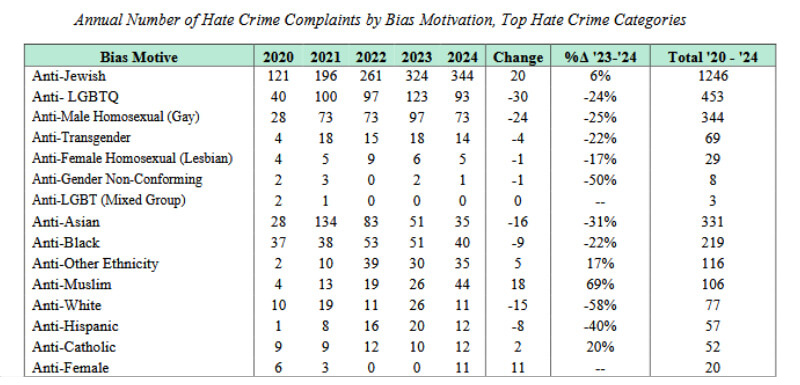
Source: NYC Office for the Prevention of Hate Crimes 2024 Annual Report
While not rising at the same rate as anti-Muslim hate crimes, anti-Jewish hate crimes nevertheless represent a disproportionately large share of reported incidents and arrests, indicating a persistent pattern within New York City’s hate crime landscape. According to NYPD annual hate crime reports, each year between 2020 and 2024, Anti-Jewish hate crimes in New York City consistently resulted in the highest number of arrests compared to all other bias motivations reported by the city.
Subsequent data indicate that the increase in anti-Jewish hate crimes has not persisted. Overall hate crime complaints in New York City declined 3% from 2023 to 2024, and total hate-crime related arrests fell by 8% over the same period. Preliminary data also suggests that anti-Jewish hate crimes declined in 2025 compared to 2024. Although full-year 2025 data have not yet been released, the most recent figures show 53 anti-Jewish hate crime complaints in the third quarter of 2025, down from 77 during the same period in 2024. Arrests also declined sharply, from 35 in the third quarter of 2024 to 13 in the same period in 2025. These trends indicate that while reported anti-Jewish hate crimes remain above the pre-7 October baseline, they may be on a downward trajectory.
Meanwhile, over the same time period, Anti-Muslim motivated hate crimes went from one of the least commonly reported hate crimes to the fourth most commonly reported hate crime, experiencing the most growth of all bias motives. The Council on American Islamic Relations said it tracked 127 violent, hate-related mentions of Mayor Mamdani and his campaign the day after he won the Democratic Primary in June 2025. Mamdani’s critics directly associated his Muslim background with the September 11 terrorist attacks in New York. Around the same time, authorities investigated a Texas man for making anti-Muslim, terroristic threats against Mamdani. He was eventually arrested and charged in September. Given the surge in anti-Muslim sentiment and reported incidents surrounding Mamdani’s mayoral campaign, it is likely that anti-Muslim hate crimes continued to increase in 2025 and could continue to do so in 2026.
Overall, Mamdani’s administration is entering a threat landscape with declining crime trends, though anti-Jewish and anti-Muslim hate crime incidents continue to be major concerns. It will be important to closely monitor the metrics laid out above to determine whether new leadership appointments and policy initiatives like the Department of Community Safety impact New York’s overall security environment.
Managing Threats Associated with Anti-Israel Social Unrest
Despite Mayor Mamdani’s commitment to reducing hate crimes, there are concerns that his anti-Israel stance could create a more permissive environment for anti-Jewish activity by anti-Israel activists. Not all anti-Israel protests are anti-Jewish, though some protest actions can extend into threatening behavior targeting the Jewish community.
For example, on 19 November 2025, anti-Israel protestors demonstrated outside of the Park East Synagogue in Manhattan against an event encouraging Jewish migration to Israel. The event became confrontational, with participants chanting slogans supporting violence such as “globalize the intifada” and “Death to the IDF.” One protest leader implored participants that “we need to make them scared.” Protestors and counter-protestors heckled each other, with several anti-Jewish insults heard in the exchange.
Jewish organizations broadly condemned the protest as a clear example of how anti-Israel activism can become anti-Jewish when they target Jewish places of worship, which are not responsible for Israeli government policies. Other protest activities, such as those that legitimize violence by designated terrorist groups, can also constitute threatening behavior, regardless of location.
As with anti-Jewish hate crimes, anti-Israel protests spiked following the 7 October 2023 attacks and the Israel-Hamas War in Gaza. According to the Crowd Counting Consortium project, anti-Israel demonstrations held in New York City surged from 41 incidents in 2022 to 1,421 in 2024. While 2025 only saw around 500 protests as of the end of October 2025, the number is still an order of magnitude higher than the pre-7 October 2023 baseline.
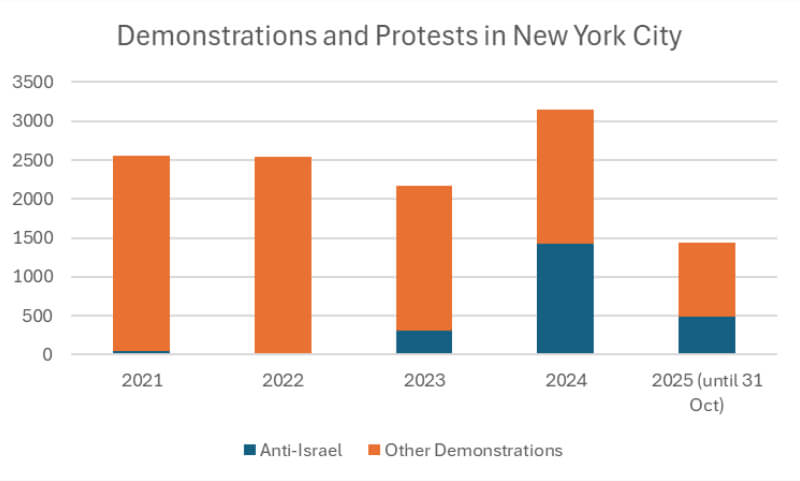
Recent data demonstrates the overlap of anti-Israel activism and anti-Jewish incidents. According to ADL’s audit of nation-wide anti-Jewish incidents in 2024, 58 percent (5,452 incidents) were linked to anti-Israel sentiment, with almost 2,600 incidents occurring at anti-Israel rallies and protests. Over 1,430 incidents occurred in New York in 2024 – more than any other state – with 68 percent of those incidents occurring in New York City alone.
Protests pose a threat to Jewish organizations and individuals when they damage and deface property, harass and intimidate by passers with offensive slurs and slogans, or lead to confrontations with counter-protestors. Activists can also pose threats beyond demonstrations, such as by vandalizing or destroying Jewish spaces, disseminating anti-Jewish literature, doxxing Jewish individuals who are supportive of Israel, or by harassing Jewish individuals and organizations online.
Given the risk of anti-Jewish activity associated with anti-Israel protest actions, security managers should maintain situational awareness of planned protest activities by particularly active anti-Israel activist groups. Groups not aligned with the Palestinian cause can also initiate anti-Jewish activities and are worth monitoring. Far-right groups and extremist members of fringe religious groups have also been known to engage in anti-Jewish incidents.
Protest activity is declining in New York, but like anti-Jewish hate crime, anti-Israel demonstrations remain well above the pre-7 October baseline. While Mayor Mamdani’s policies against Israel could encourage more protests, external factors, such as a resumption of the Gaza War, are far more likely to influence future protest activity in New York.
Anti-Billionaire Sentiment
As a Democratic-Socialist, Mayor Mamdani has heavily criticized the wealthiest New Yorkers. He has proposed tax increases on the city’s wealthiest residents and stated that he doesn’t think “we should have billionaires.” This comes amid a general increase in anti-wealth/anti-capitalist extremism best illustrated by the December 2024 murder of UnitedHealthcare CEO, Brian Thompson, and the support for the accused murderer following his arrest. While Mamdani has by no means tolerated violence against New York’s financial elite, his opposition to concentrated wealth may embolden those activists to take more extreme measures.
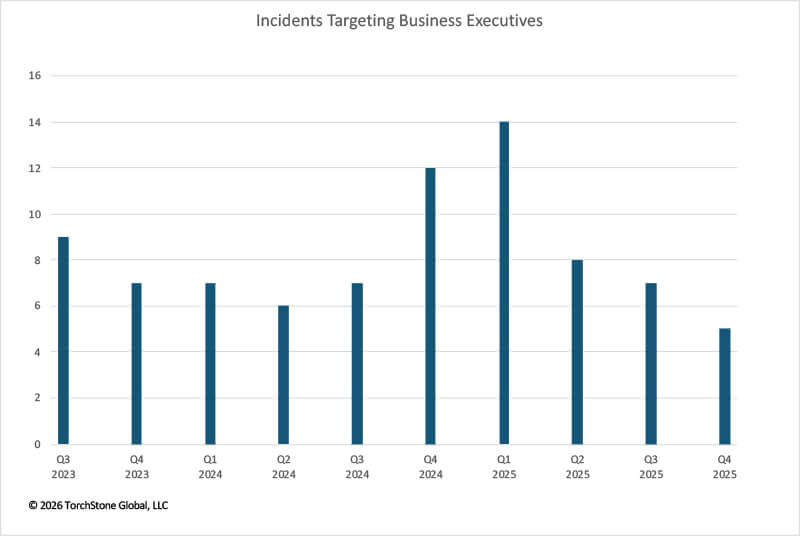
According to TorchStone’s own Executive Protection Threat Database, threat incidents targeting business executives increased 65% over the twelve-month period following Brian Thompson’s murder compared to the previous twelve-month period (43 incidents from December 2024 – November 2025 compared to 26 incidents from December 2023 – November 2024). Of the 48 incidents occurring in the United States between May 2023 and December 2025, 21% occurred in New York City. Trends clearly demonstrate that even before Mayor Mamdani took office, New York led the world in threats to business executives. New city leadership openly opposed to billionaires has the potential to exacerbate that trend.
Stay Ahead of Threats with Protective Intelligence
Regardless of politics, organizations and individuals concerned about the security environment in New York should maintain strong situational awareness of threat trends in the city. Future flare-ups in the Israel-Palestine conflict (or Israel-Iran conflict) can rapidly change the situation. Given New York’s diverse population, virtually any major geopolitical development can mobilize communities across the city. For Israel-related anti-Jewish threats specifically, it will be key to monitor for activist actions targeting Jewish spaces and people, including synagogues, schools, community centers and organizations, businesses, museums, monuments, cemeteries, events, and identifiably Jewish individuals.
Flare-ups in the Israel-Palestine conflict, or in other parts of the Middle East could also spawn anti-Muslim threats, and rising tensions should also cause security leaders to key activist actions targeting Muslims and Islamic institutions, organizations and businesses.
TorchStone Global’s protective intelligence services can help businesses and organizations maintain awareness of protest activities and track key threat trends. Monitoring relevant incidents can help clients prepare for and prevent potential disruptions, harassment, and other threats emanating from activist-type actors. A threat monitoring program can also help concerned entities track the development of these threats over time, allowing for a more data-driven assessment capability that is less reliant on anecdotal evidence and sensationalized media reports about threats.