

Annual 2025 TorchStone Global Executive Protection Report
2025 Annual Review of Trends in Executive Protection Threats
- Nationwide congressional redistricting controversies drove threatening incidents targeting state government elected officials.
- Verbal and written threats overtook attacks as the most common tactic used against high-profile individuals, highlighting the importance of monitoring grievances and denouncements before they escalate.
- Communication channels overtook the home as the most common venue of incidents, but the home remains a vulnerable location for targeted attacks.
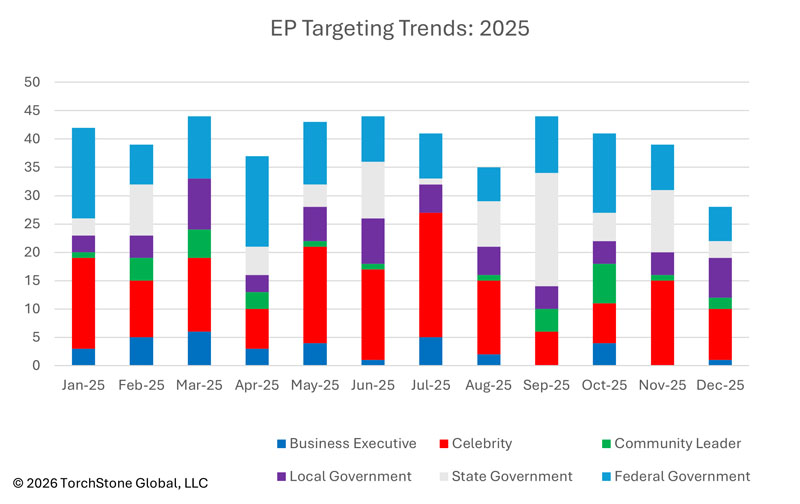
In 2025, TorchStone recorded 476 incidents targeting high-profile individuals in a marginal 3% increase over the 462 recorded incidents in 2024.
Violent threats such as the assassination of conservative political commentator Charlie Kirk in September, and the murder of Hollywood director Rob Reiner and his wife in December highlighted the complexity of keeping high-profile individuals safe. Threats can come from an ideologically motivated gunman perched 400 feet away, or from within the principals’ own family, living on the same property.
Targets
TorchStone monitors threats against the following target types:
Business Executives – Corporate leaders, including C-suite executives, business owners, and managers.
Celebrities – To include actors, musicians, sports personalities, and social media influencers.
Federal/National Government Leaders – Elected or politically appointed leaders within national-level politics, including heads of state, legislators, and national-level administrators.
State/Regional Government Leaders – Elected or politically appointed leaders within regional-level politics, including governors, state legislators, and state-level administrators.
Local Government Leaders – Elected or politically appointed leaders within local-level politics, including mayors, city council members, and local administrators.
Community Leaders – Non-elected, prominent members of civil society who are influential at the community level, including religious leaders, journalists, and activists.
Like prior years, the most common targets of incidents were celebrities, followed by federal government leaders. However, in 2025, state government leaders overtook local government leaders as the third most targeted group.

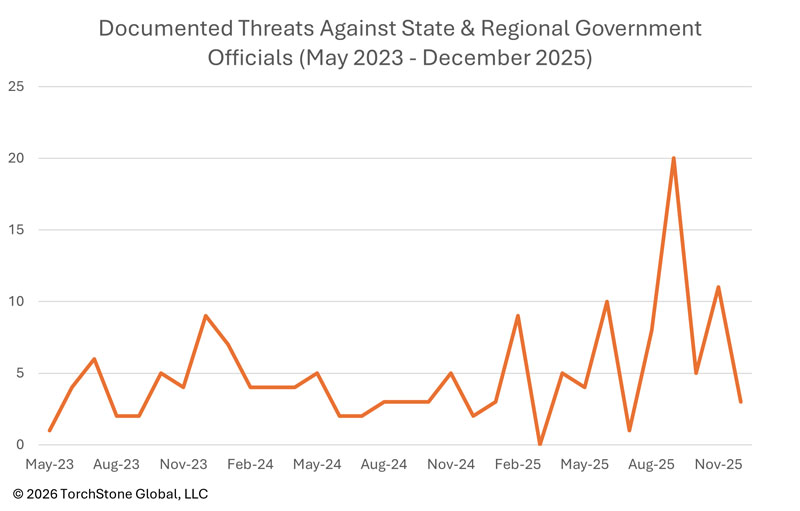
There was a 75% increase in incidents targeting state and regional government officials from 2024–2025—the biggest change in targeted groups by far.

Previously one of the least common targets, state/regional lawmakers experienced an increase in threats in 2025, particularly following the shootings targeting Minnesota state lawmakers and their families in May 2025. High-profile, controversial congressional redistricting efforts in Texas led to a spike in threats over the summer, and a similar effort in Indiana contributed to an increase in the fall. Another campaign of threats against state lawmakers emerged following the assassination of Charlie Kirk in September, many in retaliation to lawmakers’ responses to Kirk’s death.
Tactics
TorchStone organizes incidents within the following categories of tactics.
Verbal/Written Threat – Social media commentary, phone calls, emails, and letters that are often anonymous and rarely develop into something more serious but are valuable indicators of a grievance against an individual or group.
Harassment – Demonstrations of an actor’s capability and intent in addition to interest expressed through verbal/written threats. For example, TorchStone classifies vandalism and swatting as forms of harassment.
Stalking – As a threat actor moves into the attack cycle, they typically begin to follow or more closely study their target to determine patterns of life and identify opportunities to attack. Not all stalkers intend to attack, but their behavior makes them a more concerning threat that deserves immediate attention.
Attack – In extreme cases, a grievance can lead to physical violence, injury, and even death.
Other Crime – Financially motivated crime typically follows the same attack cycle but does not necessarily lead to physical violence.
Verbal and written threats overtook attacks as the most common tactic used against high-profile individuals. This is not surprising as the barrier is extremely low to issue threats through social media, email, and phone calls. Most threats via communication channels are not publicly reported due to privacy concerns, so we expect the actual number of threats via email, text, phone, or mail to be much higher.
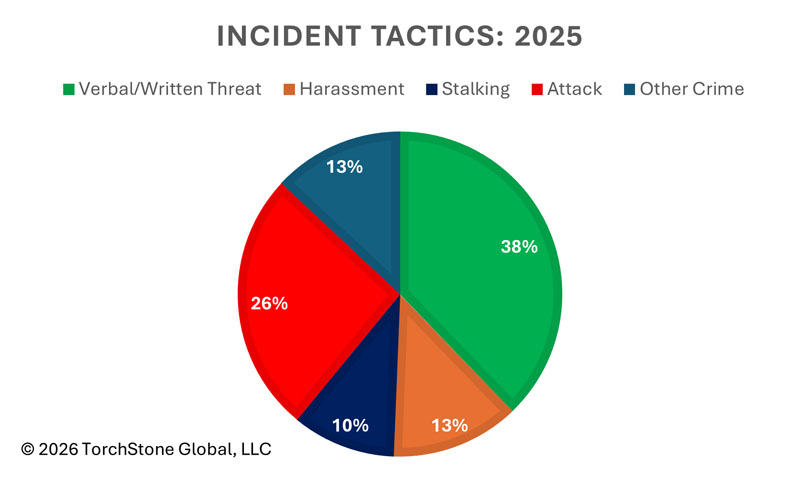

Despite the high volume of signals, monitoring verbal and written threats is extremely valuable for any protective intelligence team. Threats against an individual typically begin as grievances and denouncements–often expressed through verbal or written threats on social media, over the phone, through email, or postal mail. Monitoring these verbal and written threats provides critical clues to investigators regarding who is threatening their principals and why. Most verbal and written threats never develop beyond that, but if they mature into more aggressive actions such as doxing and harassment, it’s a good time for the protective intelligence team to elevate the threat and notify executive protection teams or law enforcement.
Venue
TorchStone organizes venues by locations where incidents are most likely to happen.
Communication Channels – Social media platforms, email, postal mail, and other telecommunication channels that allow a degree of distance and anonymity to the author of the threat.
Public Areas – Any unrestricted area not under special security measures. This includes public streets, parks, and squares.
Restricted Areas – Any area that has additional screening and security measures that make them a harder target than public areas. This includes sporting and concert venues, airport terminals, or private clubs.
Home – Private residences.
Office – Places of work, including warehouses, factories, and office buildings.
In 2025, communication channels overtook the home as the most targeted location for the same reasons discussed above in the tactics section: the barrier of issuing verbal or written threats through communication channels is low.
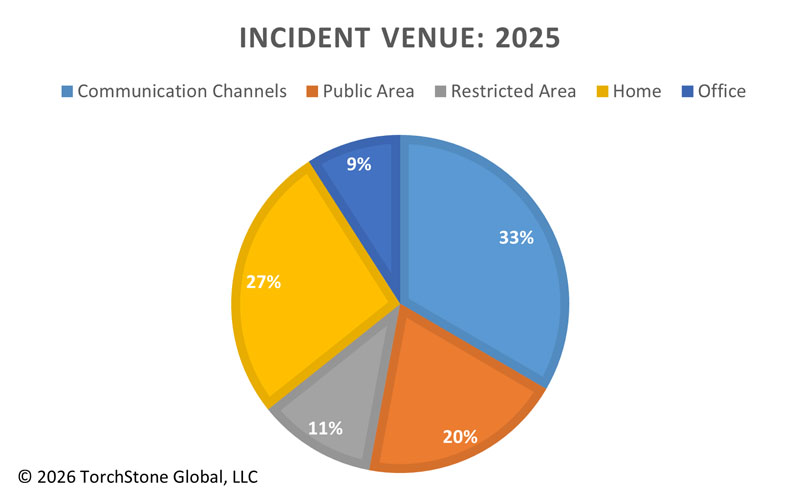
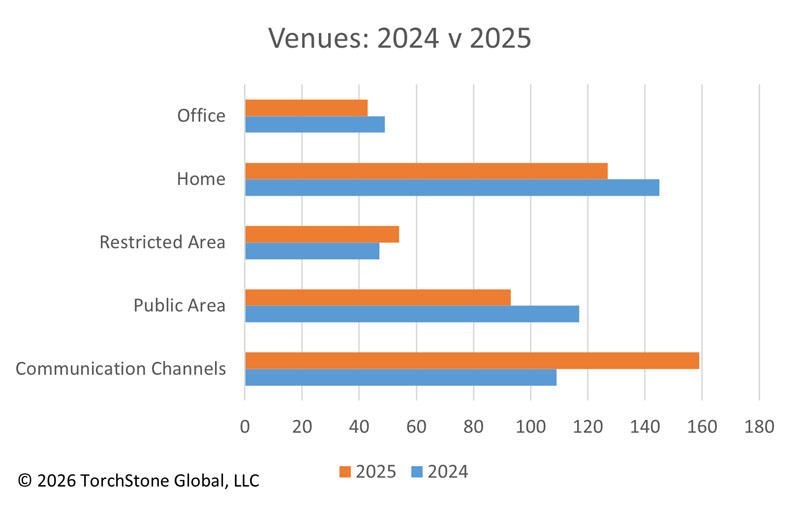
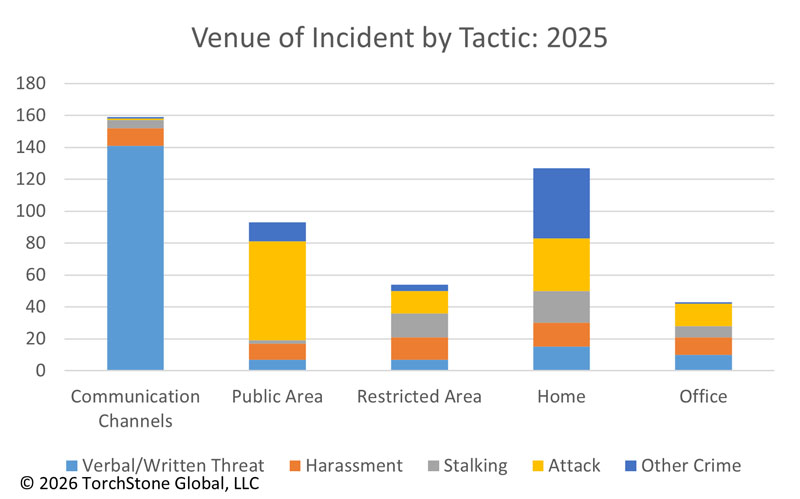
But the low barrier to issuing threats through communication channels also means that the severity of those threats is diminished; nearly 90% of the incidents targeting communication channels were verbal or written threats.
The home remained the most likely venue for more violent incidents such as stalking, crime, and attacks. Celebrities were the most likely group to be targeted. Financial gain was a major motivation for attacks on celebrity homes. For example, in June 2025, assailants broke into the Seattle area home of the performer Macklemore, assaulted a caretaker, and demanded to know where valuables were kept. The performer was out of town at the time on a well-publicized international tour, highlighting how criminal groups use prominent individuals’ public schedule to target their homes.
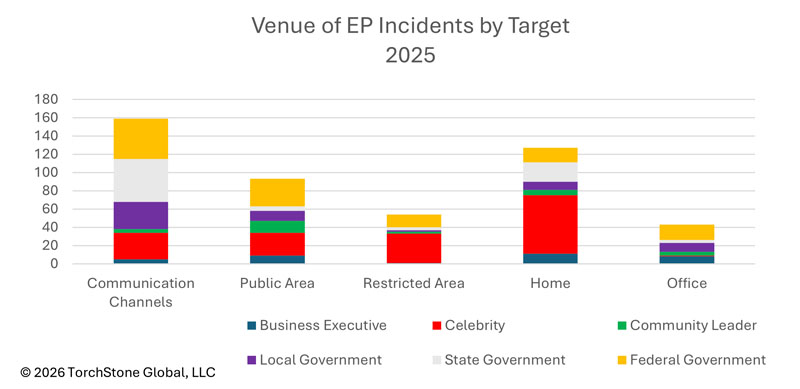
Meanwhile, exactly 50% of all reported attacks against high-profile individuals took place in public areas, where security is typically weakest. Federal government officials were the most targeted group for violent attacks, accounting for 28% of all attacks in 2025.
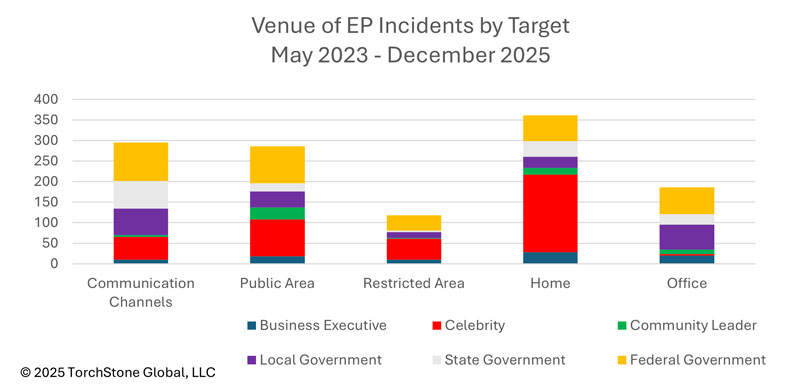
The home remains the most common venue of incidents when considering the entire dataset, reaching back to May 2023. Of all the incidents recorded between May 2023 and December 2025, 29% took place in the home.
Conclusion
The federal election in 2024 and a tense U.S. political environment in 2025 show how political trends can significantly shift threats to high-profile individuals. With a by-election set for November 2026 in the United States, political tensions are only set to further increase–along with threats to government officials. However, in many cases, trends hold steady; securing the home is still one of the most impactful things a security team can do for their principal to mitigate the threats against them.